China's High-Speed Rail for Foreigners
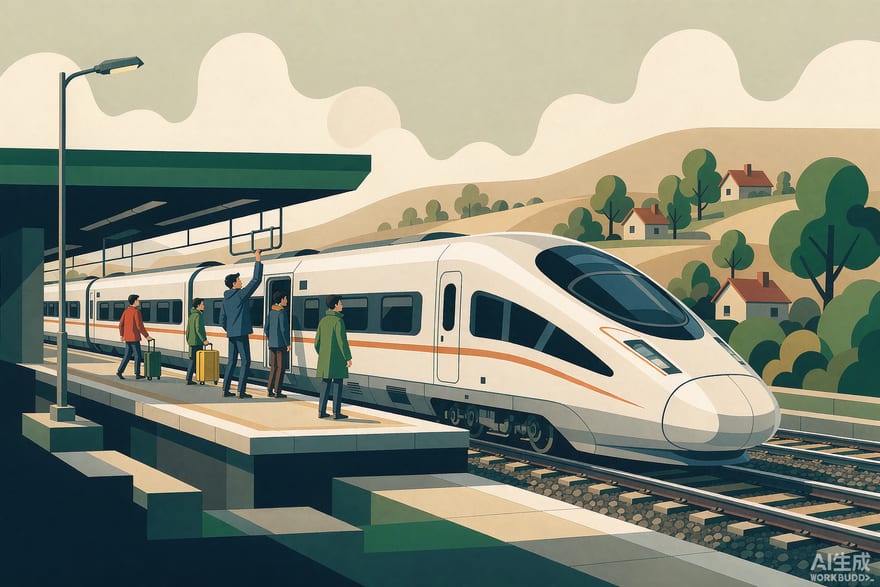
China runs the world's largest high-speed rail network — about 50,400 km of high-speed track at the end of 2025, out of 165,000 km of railway in total, according to China State Railway Group. For a visitor, that mostly means one thing: on the busiest corridors, the train is faster than flying once you count getting to and through an airport.
What it does not mean is that booking is obvious. Tickets are real-name, the official app needs passport verification before it will sell you anything, and the automatic gates at the station are built for Chinese ID cards. This page covers the parts that catch foreigners out.
The short version
- Book on 12306 (the official app/website) — it has an English version and accepts foreign passports. No booking fee.
- Verify your passport before you need a ticket. Until verification clears, you cannot buy. It can take minutes or up to 24 hours.
- Tickets open 15 days ahead, counting the travel day, at a release time set by your departure station.
- Your passport is your ticket. Bring the same original document you booked with — and expect to use the staffed lane, not the automatic gates.
The three train types you'll actually see
On the departure boards, the letter before the number is what matters:
| Prefix | What it is | Typical speed | When you'd take it |
|---|---|---|---|
| G | High-speed, the flagship service on dedicated lines | Up to 350 km/h in service | Almost every intercity trip you'll book |
| D | Electric multiple unit, often on mixed or older lines | Usually 200–250 km/h | Routes where there's no G, or overnight sleepers |
| C | Intercity — short hops between neighbouring cities | Varies by line, commonly 200–350 km/h | Beijing–Tianjin, Guangzhou–Shenzhen, Chengdu–Chongqing corridors |
You'll also see Z, T and K trains. Those are conventional (non-high-speed) services — much slower, but useful on routes high-speed rail doesn't reach.
How fast is it, really?
This is the question most people arrive with, and it's where online answers go wrong, so here are the three numbers that matter:
- 350 km/h (217 mph) — the fastest speed in commercial service today. This is what the CR400 Fuxing trains run at on lines such as Beijing–Shanghai.
- 400 km/h operating / 450 km/h test — the CR450 prototype, unveiled in Beijing on 29 December 2024. It is not yet in commercial service; line tests were still under way after the debut.
- No train in service runs at 600 mph. That figure (roughly 965 km/h) belongs to maglev concepts and research programmes, not to anything you can buy a ticket for.
For a sense of scale on the ground: the fastest Beijing South → Shanghai Hongqiao service covers 1,318 km in about 4 hours 18 minutes, and most G-trains on that corridor take between 4.5 and 6 hours depending on how many stops they make.
Booking: 12306 vs a third-party app
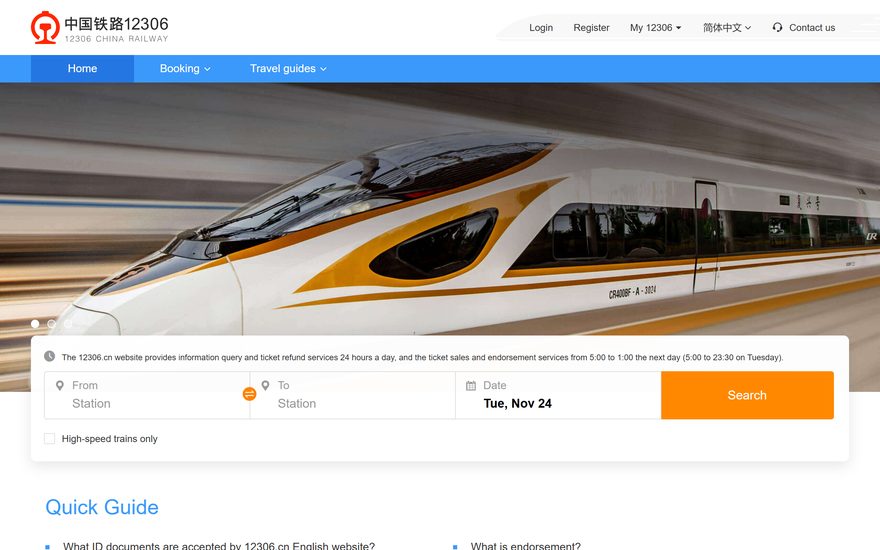
12306 is the only official online seller — the railway has never authorised another platform to issue tickets. Third-party apps sell the same seats for the same base fare with a service fee added. Which one suits you depends on how much setup you'll tolerate:
| 12306 (official) | Third-party apps | |
|---|---|---|
| Booking fee | None | Typically a few yuan to a few dozen yuan per ticket |
| Sales window | 15 days ahead | Often accept earlier pre-orders, but they can only issue once 12306 releases |
| Passport setup | Verification required before you can buy | Usually bookable immediately |
| Payment | UnionPay, international cards; Alipay / WeChat Pay are the most reliable | International cards, PayPal, Apple Pay (varies) |
| Changes & refunds | Direct, at official rates | Handled through the agent, sometimes slower |
Setting up 12306 with a passport:
- Install the official Railway 12306 app and switch it to English (Me → Settings → Version Switch → English Version), then restart it.
- Register with document type set to Passport. Enter your name exactly as it appears in the machine-readable zone of your passport — same order, no swapping surname and given name.
- Add yourself as a passenger and upload a clear photo of the passport bio page (Me → Passenger → Add Passenger). Wait for verification; if online review fails, take the original passport to any station ticket window for free manual verification.
- Search, choose a train, and pay. Unpaid orders cancel automatically, so don't wander off.
Do this a day or two before you want to buy, not on travel day. Verification is the single most common reason visitors can't book — and it's the step that can't be rushed.
Timing rules worth knowing:
- 15-day sales window, including the travel day. Each station has its own release time — check the date shown in the app rather than assuming midnight.
- Online sales close about 30 minutes before departure.
- Popular departures around Friday evenings, weekends, Spring Festival and National Day can sell out within minutes of release.
- One account can hold up to 15 passengers, but every passenger must pass real-name verification first.
- Trains to and from Hong Kong West Kowloon are cross-border — allow extra time for immigration and boarding procedures at the station.
What it costs. Fares are set by distance and seat class (second / first / business), and pricing on the busiest lines is now dynamic — the published fare is an upper limit, and actual prices move with demand and departure time, with published caps raised on some corridors since 2026. We deliberately don't print a figure here, because any number we give you will be wrong by the time you read it. Search your date on 12306 for the real price, and compare two or three departure times before paying.
At the station
- Arrive 45 minutes early; 60 at the big hubs (Beijing South, Shanghai Hongqiao, Guangzhou South). These stations are enormous, and security plus the walk to the right waiting hall takes real time.
- Check which station. Cities have several, and "Beijing Station" is not "Beijing South". Save the Chinese name of your station on your phone.
- Security — bags and electronics go through the scanner, as at an airport. Knives and flammables are prohibited.
- Ticket check: use the staffed lane. Automatic gates are designed for Chinese ID cards; some read foreign passports and many don't. Open your passport's bio page flat on the scanner, and if it fails, walk to the manned channel.
Luggage limits
These are the official free allowances — enforced at the security gate, not the platform:
| Passenger | Weight |
|---|---|
| Adult | 20 kg |
| Child | 10 kg |
| Diplomatic personnel | 35 kg |
Each item's external dimensions must total no more than 160 cm (length + width + height) — and no more than 130 cm on EMU trains, which is every G, D and C service. Rod-shaped items may be up to 200 cm on conventional trains. Each single item must weigh 20 kg or less. Anything over these limits has to be consigned as checked luggage.
Folding wheelchairs and folding prams carried by passengers who need them are free and don't count against the allowance. Balance boards and similar wheeled devices must be packed in rigid packaging.
Refunds and changes
| When you cancel | Fee |
|---|---|
| 8 days or more before departure | None |
| 48 hours to 8 days before | 5% of the fare |
| 24 to 48 hours before | 10% of the fare |
| Less than 24 hours before | 20% of the fare |
The minimum fee is ¥2. Changing your destination station has to be done more than 48 hours before departure. A ticket that has already been changed after the train departed cannot be refunded.
Children
Child tickets are sold by age, not height, on real-name services. Children aged 6 to 14 need a child discount ticket; from 14 they pay full fare. One adult ticket holder may carry one child under 6 free, provided the child doesn't occupy a separate seat — extra children need discount tickets. Bring the child's ID document: a free-travelling child still needs one to pass the ticket check.
Five mistakes that cost people their train
- Leaving passport verification to travel day. Fix it when you register, not when you need a seat.
- Going to the wrong station. Beijing, Shanghai and Guangzhou all have several; the one on your ticket is the one that matters.
- Assuming the automatic gate will read your passport. Head for the staffed lane and save the five-minute panic.
- Assuming a fixed fare. Prices move; check the date you're actually travelling.
- Booking a station, not a city. "Shanghai" alone isn't enough — Shanghai Hongqiao and Shanghai Station are 20 km apart.
Planning the trip around the train? Start with Do You Need a Visa for China?, and if you're passing through on a short stop, check the 240-hour visa-free transit rules — the clock starts the day after you arrive, not the day you land. For paying for everything once you're here, see Payments & Tax Refunds, and for city-to-city planning on a business trip, Business Trips & Factories. Turning those journey times into an actual plan is mostly a question of how many days you have — see China Itinerary for 7, 10 or 14 Days, which uses the route times above to decide how many cities a given number of days can honestly hold.
Frequently asked questions
How far in advance can I buy a ticket?
Tickets go on sale 15 days before departure, counting the travel day. Each station has its own release time, so check the date shown in the app rather than assuming a fixed hour.
Do I need a Chinese phone number for 12306?
No. An email address is enough to register on the English version, which accepts foreign passports. You do need to pass passport verification, which can take from a few minutes up to 24 hours.
One thing to sort out before you book, though: how you will pay. Fares sit well above the ¥200 threshold at which the mobile wallets start charging international cards a 3% fee, so it is worth knowing where that line falls before you reach the checkout. See Alipay and WeChat Pay for foreigners.
You may still want a Chinese number for other things — ride-hailing and local delivery services commonly confirm you by SMS. See staying online in China for the eSIM-versus-local-SIM decision.
Can I use my passport at the automatic gates?
Sometimes, but don't count on it. Automatic gates are built for Chinese ID cards. Go to the staffed lane with your original passport — it's faster than retrying the machine.
How much luggage can I bring?
20 kg for an adult (10 kg for a child, 35 kg for diplomatic personnel), with each item's length + width + height totalling no more than 130 cm on high-speed (G/D/C) trains. Heavier or larger items must be consigned.
What's the difference between G, D and C trains?
G is the flagship high-speed service, running up to 350 km/h on dedicated lines. D trains usually run 200–250 km/h, often on mixed or older lines. C is intercity — short hops between neighbouring cities, with speeds set by the individual line.
Is there a train faster than 350 km/h in service?
Not yet. The CR450 prototype, unveiled in December 2024, is designed for 400 km/h in commercial operation with a 450 km/h test speed, but it was still undergoing line tests after its debut. Everything you can book today tops out at 350 km/h.
Do I need to print my ticket?
No. Your passport is the ticket — the same physical document you booked with. A printed itinerary is not valid for boarding.
Sources
- China State Railway Group — 165,000 km of railway, over 50,000 km high-speed (4 Jan 2026)
- Xinhua — CR450 prototype: 450 km/h test speed, 400 km/h operational (29 Dec 2024)
- 12306 — Free luggage allowance (weight and dimensions)
- 12306 — Refund rules and fee tiers
- 12306 — Ticket purchase notice (refund tiers, change rules)
- MTR Hong Kong — Buying on 12306 with a foreign passport (English version, service hours, cut-off times)